FORWARD BOX JUMP: HURDLE JUMP
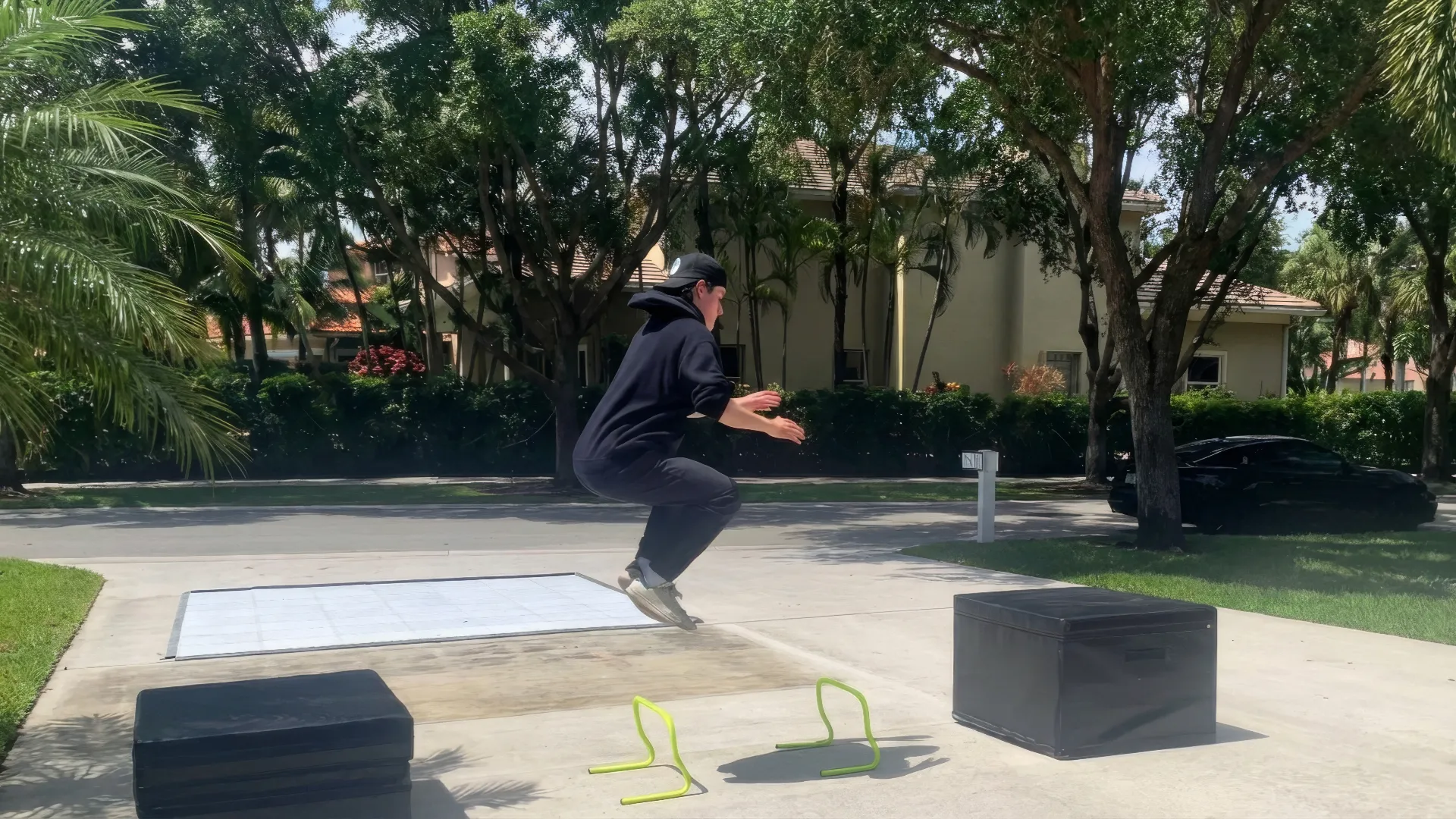
FORWARD BOX JUMP: HURDLE JUMP
FORWARD BOX JUMPS
Box Jumps are part of our Forward Jump Series and are taught in a specific progression. The Box Jump height will vary depending on ability. When you land on the box, your hip joint should be slightly above your knee joint. We are not performing these jumps for you to post on Instagram. Your training athletic performance and the landing is as important as the jump. We perform max box jumps for testing, but not for training. We will also change the method of loading before the jump to challenge a different reactive stimulus. Although the box may not be a max height, you are expected to perform each jump with maximal effort.
Forward Box Jump: Hurdle Jump
Jumping over a hurdle creates more downward force, which in turn requires more power to change direction and subsequently adds more difficulty to the jump. This type of landing will increase hip stability and loading power.
- Begin Standing in Athletic Position approximately 2 ft from a 12” hurdle.
- Jump box height will be based upon ability
- I like to see your hip joint above your knee joint upon landing. If not, the jump box is too high
- Set Up begins with arms reaching overhead at full extension, hips at triple extension through your knees and ankles. Weight on your toes.
- Load Phase starts by quickly ripping your arms to your sides, hands at hips, while dropping your hips to a half squat load position. The harder you pull down your arms, the more explosive your jump will be.
- Quickly yield momentum, properly loading your hips, and explode over the hurdle
- Focus on a proper hip cycle with knees over hips as you jump over the hurdle as well as a proper landing to yield, load and explode from for your next jump.
- Repeat this Jump Cycle onto the forward box.
- Land softly with both feet entirely on the box. This is important to develop eccentric strength, control and hip stability.
- Pause for 2 sec at the landing.
- Adding a depth drop coming off the box is also an option to allow continued work on deceleration strength