45° DIAGONAL BOUNDING W / 5 MINI HURDLES: CONTINUOUS
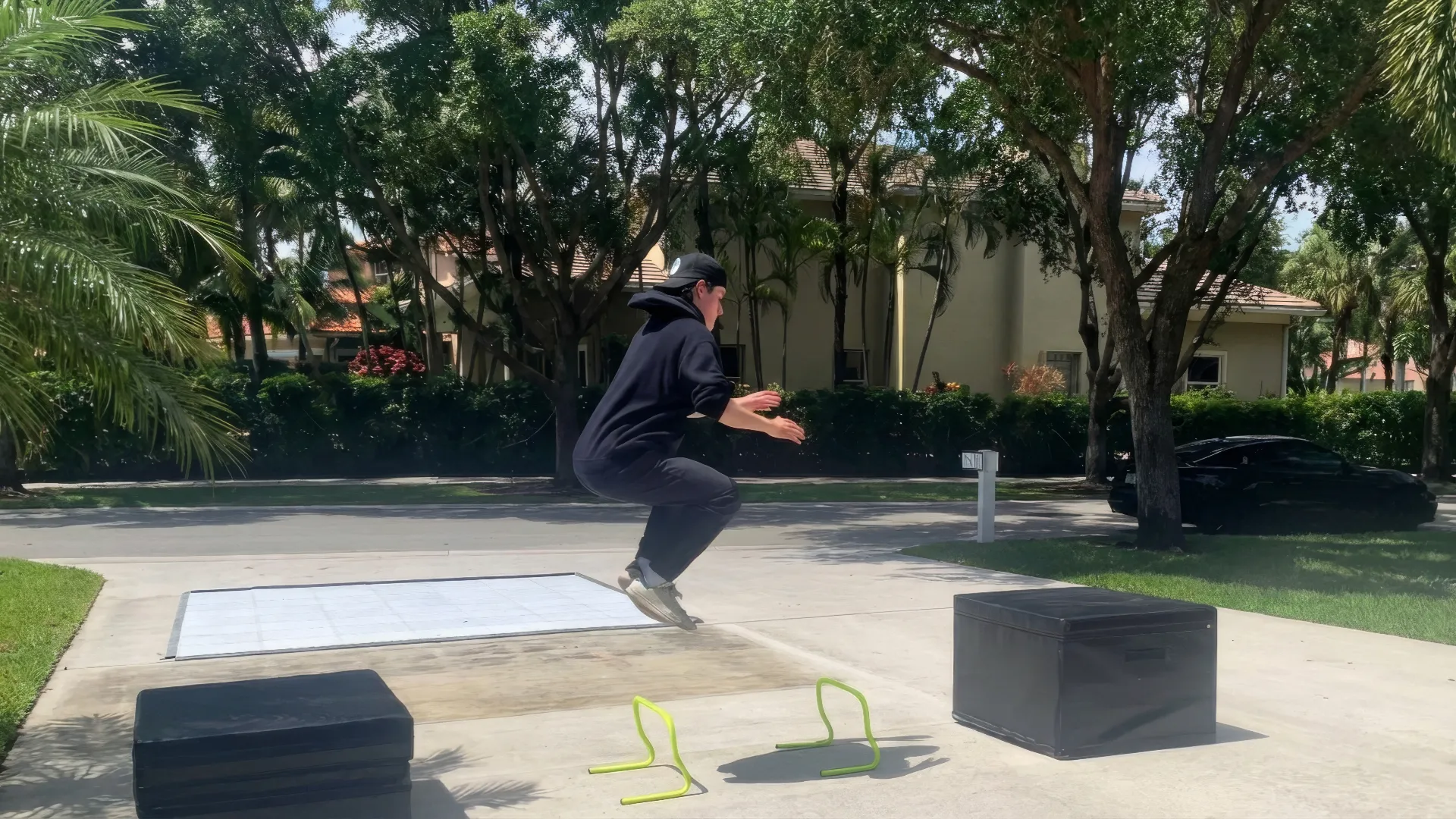
45° DIAGONAL BOUNDING W / 5 MINI HURDLES: CONTINUOUS
LATERAL BOUNDING
Due to the specific nature of the skating stride and mechanics, Lateral Bounding becomes a very important part of the training process because it helps reinforce biomechanical requirements to become a successful skater. Training an explosive lateral stride followed by a strong and stable landing onto the opposite leg are both key training components
45° DIAGONAL BOUNDING W/ 5 MINI HURDLES
45° Bounds w/ Mini Hurdles are part of our Lateral Bounding Series and are taught in a specific progression. 45° Bounding is a very popular plyometric used throughout the hockey off-ice training community. And for good reasons. The biomechanics of the exercise are very similar to the hockey stride. Our progression with Mini Hurdles allows the athlete to focus on two components of the skating stride which are the Landing Phase which requires the athlete to develop strong hip knee and ankle stabilizers to overcome momentum. And Transition Phase where the athlete recovers from the landing, maintains form and posture to transfer weight and power from landing stride to begin the drive phase in the opposite direction. Training these specific movement patterns is key to developing a powerful hockey stride.
45° Diagonal Bounding w/ 5 Mini Hurdles
Begin by setting up 5 Mini Hurdles in the same location that your landing areas would be when performing 45° Diagonal Bounding without. Width and distance of travel will vary depending upon ability, but typically the hurdles are set up about 6-8’ apart both laterally and linearly, in a zig-zag fashion.
45° Diagonal Bounding w/ 5 Mini Hurdles: Continuous
Continuous is simply repetitive jumps. The athlete will also be working on coordination, timing, and control as well as improving lower body power. Focus on a proper knee cycle over hips as you bound over the hurdle as well as a proper landing to yield, load and explode from to the next jump.
- Breakdown into an athletic single leg stance on your outside leg behind the first hurdle
- Your load hip should line up directly over your knee and foot
- Maintain proper posture with your chest up and turned toward your loaded hip. Your back rotated in the opposite direction
- Utilize of a proper arm swing on athletic posture to a counterbalance your shoulder rotation and lateral forces generated by the legs. A better arm swing will also help you generate more torque and power while maintaining better balance.
- Single leg hop over the first hurdle with opposite foot and opposite hand action
- Try to lift your knee as high as possible when hopping over the hurdle
- Without pause Bound at 45° angle forward, landing quietly in the same load position on the opposite foot just behind the next hurdle.
- Continue without pause over the remaining hurdles
- Repeat in the opposite direction starting on the opposite foot
- Hurdle distance apart is dependent upon athletic ability but typically I set them about 2 yds apart in both directions